Master’s Thesis – 3Shape
My thesis focused on future-proofing packaging for medical devices by reducing complexity, costs, and environmental impact through a platform-based design approach.
Due to confidentiality, detailed material cannot be shared, but the project resulted in new design guidelines, visual prototypes, and implementation plans supported by business cases.
From Insights to Scenarios
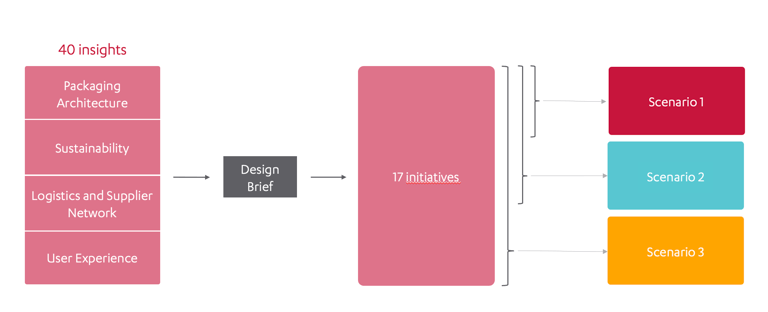
In the first phase of the thesis, we gathered 40 insights across packaging architecture, sustainability, logistics, and user experience.
These insights were distilled into a design brief, which helped align the project group, 3Shape, and academic supervisors for the next phase.
From this, we defined 17 concrete initiatives, which were ultimately combined into three scenarios. Each scenario’s impact was evaluated through a business case analysis and its environmental performance.
Milestone 1: Mapping the Packaging Portfolio
We applied a range of tools to analyze and structure 3Shape’s packaging portfolio. Using Object-Oriented Analysis (OOA), we mapped all packaging categories and components, which revealed the portfolio’s complexity. Through a Life Cycle Screening (LCS), we identified key environmental hotspots. Finally, with modularisation tools such as the Product Family Master Plan, we showed how user needs were solved through engineering principles and materialized in specific components.
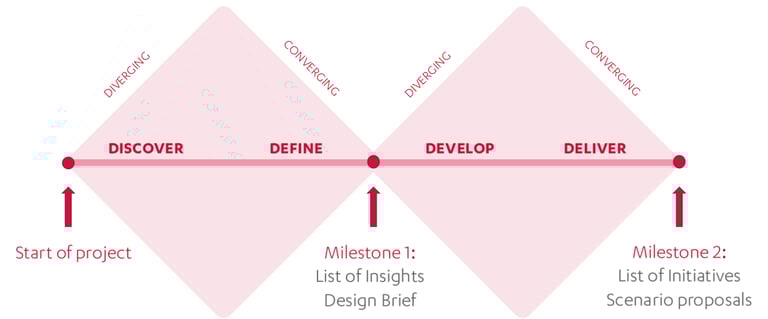
Milestone 2: Developing Scenarios
In the second milestone, we turned our findings into 17 concrete initiatives to improve the packaging system. These were grouped into three scenarios, each showing a possible direction for 3Shape’s future packaging. To understand their impact, we calculated both the business case and the environmental performance for each scenario, which gave a clear picture of the trade-offs and opportunities.
Performance and User Experience
The project achieved significant results in both cost-efficiency and sustainability, with up to 91% reduction in transport costs, a 50% reduction in operational expenses, and a 90% lower carbon footprint across life cycle stages.
Beyond the measurable performance, the work also addressed the user experience by ensuring the new packaging system remained functional and intuitive, maintaining ease of use while introducing sustainable and cost-saving improvements.